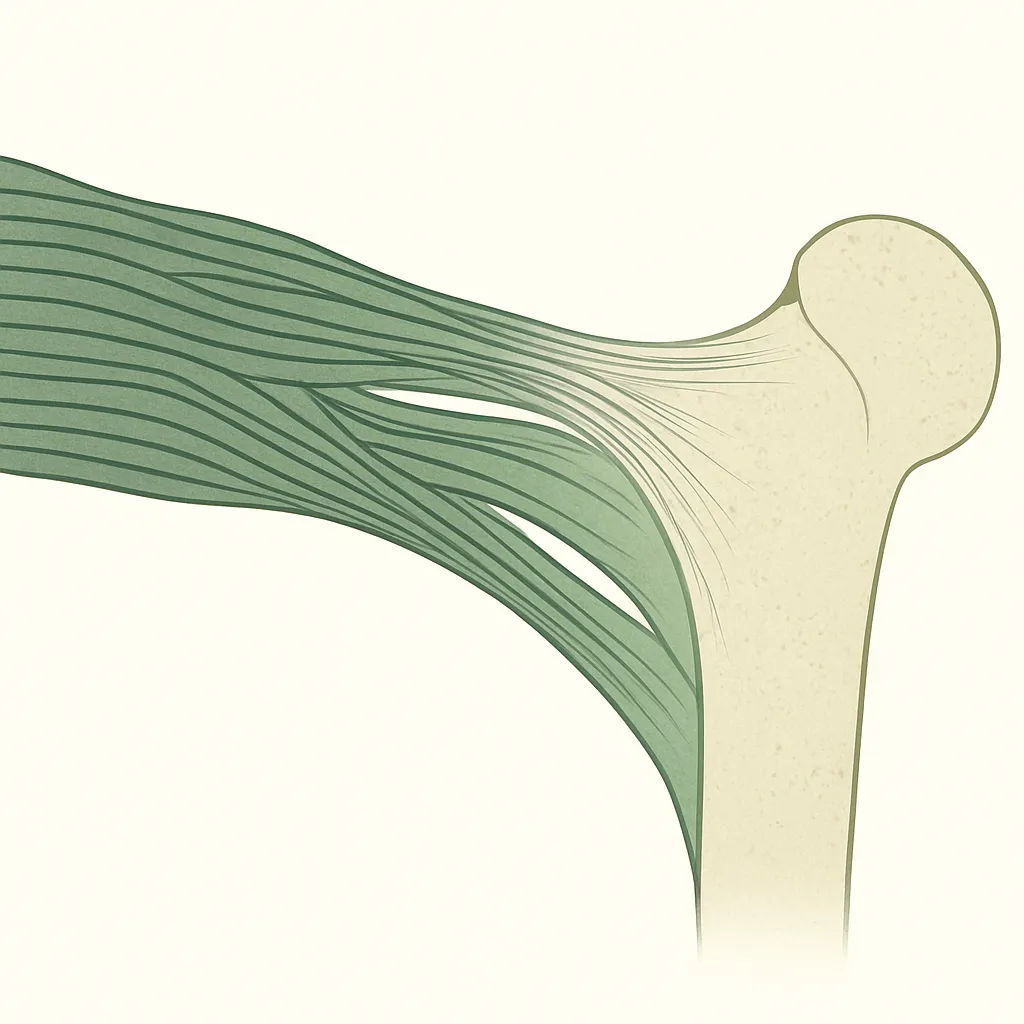
Pain-free is not the same as healed
One of the most persistent misconceptions in tendon injury is equating the disappearance of pain with full recovery. Pain is a useful signal during the acute phase, but it is an unreliable readiness test for return to sport. Tendons can undergo significant structural remodelling (or remain structurally disorganised) while producing little or no discomfort under everyday loading conditions. The tissue has simply adapted to the lower demands you are placing on it.
A systematic review of return-to-sport criteria in Achilles tendinopathy found that the field lacks agreed-upon definitions, and that subjective pain resolution alone is commonly used as a de facto clearance criterion despite there being no evidence it predicts safe return.[1] The more clinically meaningful question is whether the tendon can handle the loads it will face in competition; that requires objective testing, not just symptom monitoring.
Evidence note
Strength symmetry: the 90% threshold
Restoring strength to levels comparable to the uninjured limb is one of the most objective and actionable criteria available. The most commonly cited benchmark is a limb symmetry index (LSI) of at least 90% (meaning the injured side produces at least 90% of the force output of the uninjured side in relevant tests such as single-leg heel raises, isometric calf strength, or sport-specific hop tests).
This threshold emerged largely from ACL rehabilitation research and has been adopted across lower-limb tendon injuries because it captures functional capacity independent of pain.[3] Critically, strength asymmetries below 90% are associated with altered loading mechanics; the body compensates in ways that transfer stress to adjacent structures or create abnormal tendon loading patterns.
A limb symmetry index below 90% on strength and hop testing is associated with increased reinjury risk and altered movement patterns on return to sport.
For Achilles tendinopathy specifically, research has shown that runners who return to sport with persistent deficits in tendon loading metrics (including reduced peak Achilles tendon force and altered running mechanics on the injured side) are more likely to have ongoing symptoms.[2] Strength testing therefore provides information that symptom assessment alone cannot.
Load capacity and graded return
Even with adequate strength symmetry, the tendon must demonstrate it can tolerate progressive, sport-specific loads before full clearance. A graded return-to-sport approach involves systematically reintroducing the type, intensity, and volume of loading the tendon will encounter in competition, rather than jumping directly from rehabilitation exercises to full training.
This matters because the forces encountered in sport often exceed those in the clinical setting by a significant margin. Running, jumping, and rapid direction changes generate substantial tendon loads: direct in-vivo measurement of the human Achilles tendon has recorded forces reaching as high as roughly twelve times body weight during running and jumping.[4] A tendon that copes well with a slow heel raise may not yet have the reactive capacity for plyometric loading or explosive effort.
Research on Achilles tendinopathy in runners demonstrates that tendon loading characteristics during running, including force, stiffness, and energy storage, are related to pain, structural outcomes, and functional performance during return-to-sport phases.[2] Graded exposure tests these capacities before competition reintroduction, and persistent deficits on load-based assessment should delay clearance even in the absence of pain.
Graded return stages
Psychological readiness
Psychological readiness is increasingly recognised as an independent dimension of return-to-sport decision-making, carrying measurable consequences of its own. Athletes who return to sport with significant fear of reinjury, low confidence, or avoidance behaviours are more likely to re-injure, more likely to underperform, and more likely to withdraw from sport prematurely.
The mechanisms are partly biomechanical: fear-avoidance leads to protective movement strategies (reduced loading, altered mechanics, earlier fatigue) that paradoxically increase injury risk by placing unusual stresses on tendons and surrounding structures. The pattern is well described in ligament injury research and increasingly recognised in tendon populations.[3]
Validated tools such as the Athlete Fear Avoidance Questionnaire or the Tampa Scale of Kinesiophobia can be used to screen for high fear-avoidance before sign-off. A clinician managing return to sport should ask not only "can the tendon handle this load?" but "does the athlete believe it can, and will they move accordingly when it matters?"
The reinjury risk of returning early
The consequences of premature return are not trivial. Recurrent tendon injury is harder to rehabilitate than the original episode, carries longer recovery timelines, and in some cases leads to a cycle of partial improvement and re-aggravation that can persist for years. The structural changes associated with recurrent loading before adequate healing (including collagen disorganisation and failed matrix remodelling) are cumulative.
The systematic review of Achilles tendinopathy return-to-sport criteria found wide variation in recurrence rates across studies, in part because of the heterogeneity of clearance criteria used.[1] Studies using objective, capacity-based criteria tended to report better outcomes than those relying primarily on subjective pain resolution.
Time also plays a direct role here: tendon remodelling following injury unfolds over months, and the mechanical properties of regenerated tissue take time to mature even when loading is appropriately progressed. Published criteria for midportion Achilles tendinopathy commonly reference minimum timelines of three to six months before full sport resumption, though the biological process does not follow a fixed calendar and individual variation is substantial.[1]
Persistent deficits in tendon loading mechanics during running (not just pain) predicted worse structural and functional outcomes at return-to-sport assessment.
The bottom line
Returning to sport after a tendon injury is a multi-dimensional decision, not a single green light. The evidence points toward four overlapping criteria: strength symmetry close to the uninjured side (LSI ≥ 90%), demonstrated capacity to handle progressive sport-specific loads, adequate time for structural remodelling, and psychological readiness. Pain relief is necessary but not sufficient: it shows the tendon can cope with today's demands, without confirming it can handle the demands of competitive sport. See our evidence ratings for how this compares to other recovery interventions.
Working through a structured, criteria-based progression with a physiotherapist or sports medicine clinician (rather than relying on how the tendon feels) is the most reliable way to reduce the risk of a setback and return to full performance durably.
Medical disclaimer
This article is for educational purposes only and does not constitute medical advice. It does not establish a doctor-patient relationship. Always consult a qualified physiotherapist or sports medicine clinician before making return-to-sport decisions following a tendon injury.
References
- Habets B, van den Broek AG, Huisstede BMA, Backx FJG, van Cingel REH. Return to Sport in Athletes with Midportion Achilles Tendinopathy: A Qualitative Systematic Review Regarding Definitions and Criteria. Sports Medicine. 2018. View on PubMed
- Corrigan P, Hornsby S, Pohlig RT, Willy RW, Cortes DH, Silbernagel KG. Tendon loading in runners with Achilles tendinopathy: Relations to pain, structure, and function during return-to-sport. Scandinavian Journal of Medicine & Science in Sports. 2022. View on PubMed
- van Melick N, van Cingel RE, Brooijmans F, et al. Evidence-based clinical practice update: practice guidelines for anterior cruciate ligament rehabilitation based on a systematic review and multidisciplinary consensus. British Journal of Sports Medicine. 2016. View on PubMed
- Komi PV. Relevance of in vivo force measurements to human biomechanics. Journal of Biomechanics. 1990. View on PubMed